The Art of Josef Kosuth Examined the Conceptual Relationships Between Visual Images and
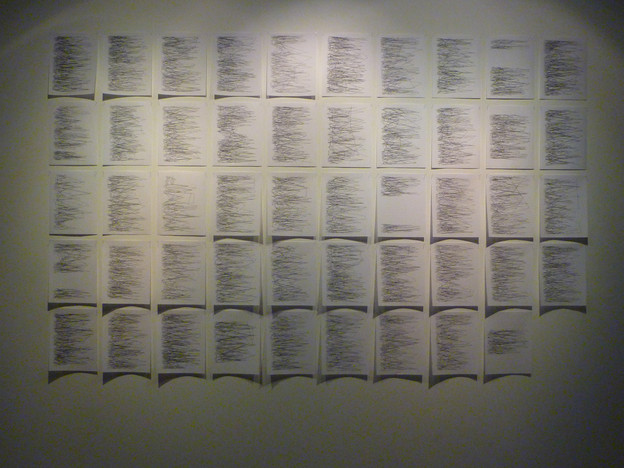
What constitutes conceptual writing is still up for debate. For more a decade, poets and critics have been claiming, reclaiming, or disclaiming the territory of conceptual writing. Who'south in? Who's out? What are its limits? Isn't all writing somewhat conceptual? Or, conversely, doesn't the very human activity of writing prevent any kind of pure conceptuality? Only in all the dorsum and forth, two facts remain firm. 1, that conceptual writing—however we ascertain that term—has come to stand for a new avant-garde in poetry and poetics. And two, that the term conceptual writing alludes to Conceptual fine art. At present that we're at least 8 minutes in to conceptual writing's fifteen minutes of fame, it's time to query that relationship. Is poetry just 50 years behind the fine art world? Or are so-chosen conceptual writers up to something else? — Katie L. Price
Respondents: Jacquelyn Ardam, derek beaulieu,Mashinka Firunts, Michelle Taransky,Andrea Quaid, Christine Wertheim
A response by Jacquelyn Ardam
Conceptual writers and the critics who love them are fond of locating conceptual writing'south theoretical framework in the foundational texts of the Conceptual art motility. Sol LeWitt's statements that "the thought or concept is the nigh important aspect of the work," and that its "execution is a perfunctory thing" have been taken upwardly by many conceptual writers as a sort of mantra. Kenneth Goldsmith, for example, has suggested that conceptual writing needs a "thinkership" rather than a "readership," while Vanessa Place and Rob Fitterman declare that "pure conceptualism negates the need for reading in the tradition textual sense — ane does non need to 'read' the piece of work equally much as recollect about the idea of the work."
The outcome: conceptual writers and their critics tend to focus on ideas, concepts, procedures (the methods of a text's cosmos) over and in a higher place questions of aesthetics, form, and the particularities of the actual text on the page. But if nosotros have learned anything virtually Conceptual art in the past 40 years or then, it is that nosotros cannot completely ignore aesthetics in favor of concepts, that talking about LeWitt's extraordinary wall drawings without mentioning the sheer, dizzying, scale of them, leaves so much to be desired. The interpretation of the work of art, of whatsoever work of art, whether written or visual, spatial or temporal, that ignores questions of aesthetics and class in favor of conceptual-just interpretations, seems inadequate at best.
What exercise Conceptual art and conceptual writing take in common, and then? Their producers deny aesthetics in favor of ideas in their manifesto-ish texts, only the works themselves demand that we apply multiple frameworks in their interpretation. They claiming united states not to view or read merely conceptually, but to read or view conceptually likewise as aesthetically. The artists and writers behind the movements ask usa to "think" nigh, rather than "read" their works, merely the works themselves ask us to do both; to think about procedure, author, thought, yes, only to add that conceptual framework to our already-existing interpretive modes. We do not and so much need to read conceptual work conceptually, just to read conceptually in improver to reading aesthetically, formally, historically, theoretically. Simply put, Conceptual art and conceptual writing demand more than of their viewers and readers; both movements ask us to read more expansively, not less, and the question of how to interpret these works is part and parcel of the works themselves.
Conceptual fine art and conceptual writing, then, make specific demands of their audiences. They challenge our existing interpretive frameworks, and inquire us to comprise more. They crave readerships, viewerships, and thinkerships; they crave us to be as tuned in to concepts as we are to aesthetics, and they inquire us to interrogate our usual habits of seeing and reading. The conceptual work is as interested as much in its reception as it is in its creation.
A response past derek beaulieu
For me Conceptual art and conceptual writing are related in their aligned dedication to data and data. Conceptual writing is, at its core, an exploration of media and how media informs writing, or, equally Douglas Huebler stated, a writing through "the facticity of [...] raw information without worrying well-nigh supposed meanings." A number of conceptual artists explored textual data — Sol LeWitt's painting instructions, Joseph Kosuth's definitions, Dan Graham's "Verse form-Schema," Carl Andre's typewriter and graph newspaper poems — and these exemplars are all stylistic forerunners that inform my ain do.
These sentences comment on conceptual writing, only are non conceptual writing.
A response by Mashinka Firunts
"Conceptual Writing and the Politics of Publicity"
"Absolutely no relationship at all," Joseph Kosuth suggests.[1]
Alternatively: a transhistorical encounter between data managers across the briefing table of a data resources business firm. Conceptual fine art, in Alexander Alberro'southward influential account, appears on the scene as a "symbolic ally" of informatization and the "multinational corporate world of the 1960s."[2] Information technology mimics and circulates through the logic of global majuscule. In Craig Dworkin's formulation, it traffics in "information most information."[3] Conceptual writing, in turn, responds to the twenty-first-century intensification of these systems. Its trajectory is aligned with what Lawrence Lessig terms "remix culture," and Lev Manovich calls the "database logic" of new media. As Dworkin aptly puts it, "the guiding concept backside conceptual poesy may be the thought of linguistic communication every bit quantifiable data." The broadband poet gain as a mechanism for filtering existing data flows — per Kenneth Goldsmith's assertion in a text subtitled Managing Language In the Digital Historic period.
In the spaces generated through accelerated information streams, the conceptual artist and the conceptual poet intersect equally information managers.
It's in this infinite, for instance, that the artist Lawrence Weiner produces Fine art as Idea as Idea. His series exhibits linguistic data harvested from dictionaries as Photostat reproductions of the definitions of "water," "idea," and "meaning." Consider aslope this process Dworkin's diagrammatic Parse, Vanessa Identify's reprinted Argument of Facts, and Goldsmith's transcribed Day. Each of these elides content innovation in favor of what Alan Liu identifies, amongst the primary features of corporate knowledge work, equally "the control of data."
"Intelligent information management is all about providing the right access to the correct information at the correct time." It calls for content marketers. See publicist-impresario Seth Siegelaub. In Lawrence Weiner'southward recollection, "he was the advertising agency." Whereas the dematerialized art object seemed poised to chart alternatives to market orientation, as Lucy Lippard proposed; its commodity status was near immediately reinscribed through novel mechanisms of publicity and promotion.[4] Amongst these efforts, conceptual artists' theoretical texts intermittently veer into the vernacular field of the slogan: fine art every bit idea as thought/the idea is the machine that makes the art/the globe is full of objects … I practise non wish to add whatever more than.
Flirting with the intensified ethos of information management, much conceptual writing cannily traffics in the kinds of capital that accrue to strategically branded Warholian personae. Its more recent post-digital variants remediate the self-promotional content of social media networking platforms into books of verse that enter into an space recursive loop wherein they, themselves, become the subjects of promotional status updates.
Recently, Vanessa Place CEO founded the transnational information services corporation, VanessaPlace, Inc. Its mission is to "turn cultural upper-case letter into capitalized civilisation" through the mantra " we are what nosotros sell, we sell what we are." The website vanessaplace.biz hosts the video work Poesy Logos, a scrolling marquee of company slogans. Two of these are: in the hereafter everyone will exist language and the trick is non-communication . A third, post-obit Lee Lozano, might be general strike .
[1] Kosuth'south exclamation responds to an inquiry into the relationship betwixt his own artistic and literary practice. Joseph Kosuth, Art After Philosophy and After: Collected Writings, 1966-1990 (Cambridge: MIT Press, 1991), 51.
[two] Alexander Alberro, Conceptual Art and the Politics of Publicity (Cambridge: MIT Press, 2003), 2.
[3] Dworkin'due south introduction to Against Expression , "The Fate of Echo," offers an of import account of the relationship between conceptualist creative practices of the 1960s and related contemporary literary experiments. He makes a stardom between the ii categories on the basis of context, or Wittgensteinian meaning-in-apply. Craig Dworkin, "The Fate of Echo," in Confronting Expression: An Anthology of Conceptual Writing , eds. Craig Dworkin and Kenneth Goldsmith (Evanston: Northwestern Academy Press, 2011), xxvii.
[four] Lucy Lippard, Six Years: The Dematerialization of the Art Object from 1966 to 1972 (Berkeley: University of California Press, 1973), 263.
A response by Michelle Taransky
In 1959, Brion Gysin said that writing was fifty years behind painting. And information technology still is. So if conceptual fine art happened fifty years ago, we're just beginning to get effectually to it now. These are ideas that accept never been explored in poetry. We've had a little fleck of pastiche, a little flake of — you know, a line from here, a line from there. But we've never had the concept of lifting something that y'all didn't write and moving it over five inches, proverb that information technology's yours, and claiming that information technology's a newly authored text.
In the 1960s, Sol LeWitt said something like "Conceptual art is only good if the idea is good." I think that conceptual writing would concord, at least the all-time of it would. Like anything else, conceptual writing is looking for that "Aha!" moment, when something so unproblematic, correct under our noses, is revealed as being monumental, profound, and transcendent. I think that writers ofttimes endeavor too difficult in the proper name of expression, when often it'southward just a affair of reframing what'due south around you lot or republishing a preexisting text into a new surroundings that makes for a successful work. Of course this is nothing new: think of John Cage's notion of silence or Duchamp'due south urinal. Simply when information technology comes to writing, these approaches have rarely been investigated.
I'm always shocked at how narrow the discourse around contemporary writing is as compared to contemporary fine art. Contemporary art has long staked a space in hybrid practices, ones that are both conceptual and identity-based, ones that at once reify and question notions of identity, destabilizing and deconstructing them in compellingly complicated ways. Think of the practices of Adrian Piper, David Hammons, Jimmy Durham, Kara Walker, Gran Fury, Felix Gonzalez-Torres, Rirkrit Tiravanija, Martha Rosler, Tania Bruguera, Jayson Musson, Sharon Hayes … the listing could go on and on. I tin't imagine that any i of these artists would self-identify as "avant-garde" nor practise the disquisitional discourses around their work invoke that term. Why does the discourse effectually contemporary writing still feel the need to cling to binaries like "mainstream" and "avant-garde?" Somehow by upholding such binaries in a critique of binaries only serves to reinforce those same binaries. Conceptualism was not prescriptive. While the discourse surrounding such a predominant mode of writing appeared hegemonic and canon-edifice, the writers involved in the movement had no such agenda; ours was a response to applied science and offered one mode of framing language and its new modes of slippage in a new landscape. As Sol LeWitt so elegantly wrote in 1967, "I exercise not advocate a conceptual form of art for all artists. I have establish that information technology has worked well for me while other ways accept non. It is one way of making fine art; other ways adapt other artists." The form remains open to reimagination, reinvestigation, and reframing (I'll Drown My Book: Conceptual Writing by Women, for instance). In the stop, conceptualism was another tool in the writers' toolbox, no more than, no less.
Facebook, Inc. "Kenneth Goldsmith's Facebook page." Last modified January 17, 2015. Accessed November five, 2014–Jan viii, 2015. https://www.facebook.com/kenneth.goldsmith.739
A response past Andrea Quai d
"Sentences on Conceptual Writing"
1. the view from the sea
2. In that location's a wall behind you, aye, there's a wall to one side, yep, there's no blank wall with —
3. And with that the Predator dies
iv. w w w w a wa
5. Described Sailboats Thegn Woophy Diaphoretic Paleethnology Kardashian Vespa Lapdance Onita Organiz
vi. <?xml version="ane.0" encoding="UTF-8"?>
7. Afghanistan is great, merely much smaller
viii. 1. The side by side poem was inspired by something I overheard at the Buffalo Pecker
9. Good afternoon, Ladies and Gentleman. My offset Kr
ten. I'll just commencement: no matter what I do I never
eleven. Eyelids open. Tongue runs beyond upper lip moving from
12. Once an angry man dragged his begetter along the basis through own
13. Declassified and
14. lets see — ok — what — we're at 8 correct now — this is 8 — sea shore rose — uhhh — this niggling garden — yeah — is
15. On October 21, 2007, Ben was 13 years old, living with his family in
16. From philosophy comes The New Acrostic (a fashion
17. flood
18. If there'south 1 thing that's sure for everyone, at all times,
nineteen. Armored
xx. DEDICATION ON NOVEMBER 9, 1923, at 12:30 in the afternoon,
21. The poems [of our era] [are designed to disappear. [and disappear]
22. pitiful and memory children april quicken burning
23. FOR A LONG TIME I have hesitated to write a volume on man. The sub —
24. abandonwoment
25. 1. Conceptual writing is allegorical writing.
26. three equal vertical bands of black (hoist side), red, and green,
27. 
28. I, Trisha Depression of Singapore, Singapore, The World, The Milky way, The Universe declare that this is
29. what is the thing with you ?
xxx. Before endmost my eyes, I telephone call the venerables, reverends, to organize
31. "At that place is something in us that tin be without us, and will be after us, though indeed it
32. In the FBI, the unapprehended and unidentified perpetrator of a
33. 1 twenty-four hours I found a tumblr called Kim Jong II Looking At Things. I could not stop looking at
34. ADVERB PREPOSITION OF THE
35. this is the story of a language and some bodies
Harold Abramowitz, Caroline Bergvall, Alejandro Miguel Justino Crawford, Craig Dworkin, J. Gordon Faylor, Robert Fitterman, Sophia Le Fraga, Kristen Gallagher, Kenneth Goldsmith, Diana Hamilton, Josef Kaplan, Jen Karmin, Tan Lin, Trisha Depression, Holly Melgard, Feliz Lucia Molina, Yedda Morrison, Joseph Mosconi, Chiliad. NourbeSe Philip, Vanessa Place, Dan Richert, Kim Rosenfield, Ara Shirinyan, Carlos Soto-Roman, Juliana Spahr, Mathew Timmons, Mónica de la Torre, Divya Victor, Chris Sylvester, UNFO, Christine Wertheim, Joseph Yearous-Algozin, Steven Zultanski
A response by Christine Wertheim
"Some Thoughts on Conceptual Writing"
In contemporary fine art circles, conceptualism is often idea in opposition to aestheticism, a term applied to art that supposedly aims to evoke sensual pleasure or beauty. Kant advanced a different formulation of the "aesthetic" equally an affect aroused when a listenencounters something it cannot comprehend and define with a concept. At least 2 things can happens here. Ane, the mind withdraws from externalities, turning in to reverberate upon (a lack within) itself – oft chosen "critique." Or 2, remaining externally focused, mind creates a wholly new concept to name the provoking experience. Kant had in heed the new concept "mass," necessary to explain the relationship between matter and dispatch in gravity. For Kant, aesthesis was mostly aroused past natural phenomena – crashing icebergs and infinite alpine vistas. I thing that couldnotdo it for him was art, because, being man-u-factured, art is by definitioncomprehensible. In the 1940'due south Clement Greenberg believed a truly aesthetic and incomprehensible manmade miracle had finally arrived in the course of Abstruse Expressionism.
Can nosotros remember conceptual art in relation tothisidea of the aesthetic? Co-ordinate to Peter Osborne, nosotros can. In Osborne's view, what distinguishes the ii is that, where traditional fine art achieves aesthesis by presenting a relatively uncomplicated experience of incomprehensibility, e.chiliad. an Abstruse Expressionist painting, in a conceptual piece of work the ungraspable element is more complex. For case, let us consider I Billion Dots (1971), reproduced in color in 2008 as One Billion Colored Dots, a piece of work by Robert Barry composed of precisely i,000,000,000 printed dots, xl,000,000 in each of 25 volumes.Osborne'southward point is that whilst in this work nosotros have both a graspable phenomena – the 1,000,000,000 dots, which you could count if you lot had fourth dimension – and a well-defined concept –One Billion Dots – still something fails to cohere, and inventing a new concept to proper noun it will not resolve the problem, for the ambivalence liesbetween the material and the concept/idea. Of form many works from all ages have this quality. Most images of the Divine aim at information technology, as practice many images ofthe Adult female. Can we chronicle this perspective to contemporary conceptual writing?
Clearly Osborne only deals with pieces performingartful piece of work – provoking the heed to a sense of its own limits (whether experienced as sublime or traumatic). Non all conceptual art does this. Neither should all conceptual writing. But that which does can be neither pure information nor pure idea, for in this definition the aesthetic dimension liesbetween the matter and the signifiers, making the material dimension as important as the conceptual/informational.
One such work is NourbeSe Philip's Zong ! (2008), which rigorously insists on both the materiality of the page and the characters sinking into its depths, and the conceptual meanings of its words – "black folk being drowned." Between these two something does neglect to cohere – the intentions of those doing the drowning. At this point we return to the critical or self-reflexive aspect of artful feel, namely that something is wanting in the mind. In this case, the lack is non conceptual. It isethical. It has become unfashionable to speak of the sublime/trauma.Zong! presents a clear statement for its render.
Source: https://jacket2.org/commentary/what-relationship-between-conceptual-art-and-conceptual-writing
0 Response to "The Art of Josef Kosuth Examined the Conceptual Relationships Between Visual Images and"
Post a Comment