How to Draw a German Ww2 Plane
Powered flight has at present been going since 1903 when the offset uneasy takeoff by the Wright brothers in a motorised glider took the human race into a whole new world of adventure.
With fourth dimension, however, many distinctive aircraft have emerged, and none more so than combat aircraft. In this tutorial, come with me as we look at drawing an iconic plane from World War two, the Supermarine Spitfire.
i. How to Fix Up Accurate Perspective
Pace i
Firstly we are going to establish a guideline for our aeroplane, get-go with a horizon line. Since the Spitfire has a rather distinctive wing shape, we want to draw the airplane at an bending that best demonstrates this, so you lot want to be drawing your horizon line across your page just above the halfway point.


Step 2
For this cartoon nosotros are going to be using just a single vanishing point. This particular point needs to exist correctly placed, and with this specific film y'all may find this is off the page. Therefore, to set this up correctly, you may have to apply a single piece of masking tape placed on one side of your canvas (information technology will be the correct side in this item case) then add your point using a steel ruler.


Step 3
Having drawn your vanishing point, take your ruler once more and draw a single line from the bespeak across the canvass mark the middle of the aeroplane body.


Footstep 4
Next, describe a line that will be used as a guide for the top of the body.


Step v
Then, describe in a 3rd line that will be used equally a guide for the bottom of the body.


Step half-dozen
We need to add pointers for the wings, which of course are essential to whatsoever aircraft. Starting with the wing closest to the viewer, a line needs to exist drawn from the vanishing point to the point where the tip of the wing will be.


Pace seven
You then need to draw in another line for the opposite wing. At this signal, if you lot take placed your points correctly, a fan-similar design should exist emerging.


Step 8
To finish this stage, we need to add ii more lines both at converging angles, which volition be for the rear flaps that come up out of either side of the rear of the plane and the rudder at the rear. These additional parts help steer the aircraft and give it stability in the air.


Step 9
At present we take rough guidelines that we can utilise to start blocking our aircraft out.


2. How to Create a Plane From Basic Shapes
Footstep one
At present that we accept established the perspective setup for our Spitfire, we will block it out using elementary shapes. We shall start with the trunk, which you can brand using a unproblematic long angled box. If you have gear up up your guide correctly, it should be fairly simple to describe this shape.


Step 2
We shall work on this plane going from left to right, simply if you are left handed you can work in the opposite direction. On pinnacle of the original box needs to get a smaller cube for the cockpit area.


Footstep 3
Alongside our beginning ii shapes need to come the wings, and for these we are looking to create simple triangles that will course a basic construction of this section of our aircraft. We shall start with the one closer to us.


Step 4
Don't forget to draw in another triangle for the 2d wing on the reverse side.


Step 5
For the rear flaps of the plane, nosotros need to draw another two triangles, but brand certain these are half the size of our offset ii.


Step 6
For the main section of the rear rudder, we need to add an upwardly angled triangle.


Step 7
A thin rectangle should then be drawn, placed to the right alongside the triangle in Footstep 6, which will exist for the steering section of the rudder.


Step eight
Y'all can too add a small-scale cube underneath the body of the plane that will be the trailing wheel which supports the rear of the shipping on the ground.


Footstep 9
Hopefully, you should at present have a skeleton of a plane that looks something like this!


iii. How to Depict an Aircraft in Particular
Step 1
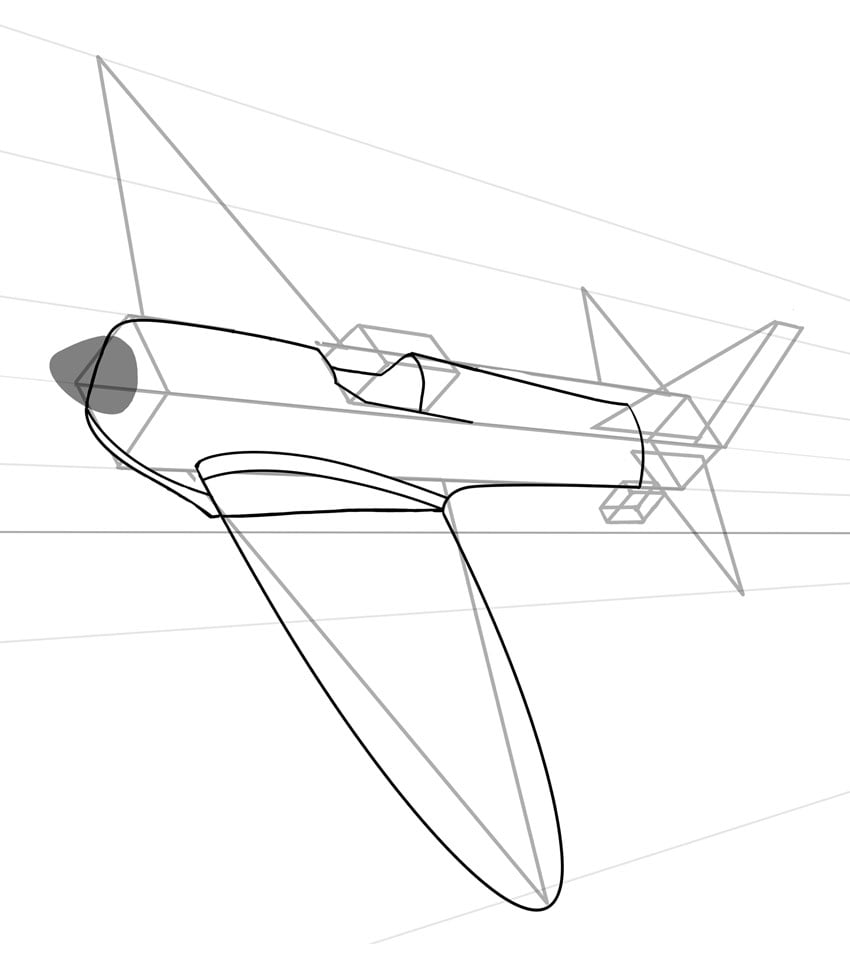
Having got the skeleton of our plane set upwards, we shall now describe it in more detail. You will have to utilize a steady hand and a lot of care if you are using ink at this point! In one case more, we shall work left to right and outset with the olfactory organ of the plane.


Step two
We then move on to the body department as it follows the nose. At this stage, avoid drawing in the details in the cockpit department as it's more important to get the main parts of your aircraft correct before going into fine detail.


Step 3
Afterwards the body section, you lot tin now add the wings. The Spitfire has a rather distinctive rounded wing shape, which makes information technology instantly recognisable to enthusiasts. For pilots, it also made it a much better handling machine than its counterparts, and so make sure you accept time to become this function right.


Stride 4
For the opposite wing, the perspective and angle of the aeroplane touch on how much we tin meet, and then a off-white section will be subconscious past the cockpit and engine compartment.


Step 5
Like the primary wings, the rear flaps take a rounded shape so demand to exist drawn with care. The Spitfire was ane of the very last front line propeller fighters to characteristic a large front fly design; modern-twenty-four hour period fighters all adopt a large arrow-like shape.


Step six
Following on from the flaps, we now movement to the tail of the plane. Again, aerodynamics and like shooting fish in a barrel flight were in mind with the design of this aircraft, and then a rounded tail was a must, with a large rear rudder section.


Footstep 7
To complete this stage, we can now add the rear abaft bicycle in more than particular.


Step 8
Now, we should have a more refined analogy to await at. During World War Ii, the Spitfire was assisted in bringing down enemy planes by the Hawker Hurricane. The Hurricane was of a slightly less aerodynamic blueprint merely only as effective at bringing down enemy bombers. The main fighter plane enemy to face the Spitfire was the German Messerschmitt BF109, which had a similar top speed to the Spitfire but was not quite as like shooting fish in a barrel to fly, thus giving British pilots a slight border in the air.


4. How to Add Finishing Touches to an Aircraft
Step ane
Nosotros at present come to the finishing details. This is the part where all the pieces come together and y'all can add your own little touches to actually personalise your own creations.
Beginning, we can add the propeller of the airplane and, as the aircraft is in motion, information technology is very simple to draw a bones ellipse. Be sure to practise cartoon these kickoff if yous experience you need to!


Step 2
To give the impression of motion, vary the thickness of your drawn line and erase little sections of your circle with a fine eraser. If you wish, you tin add in some zig-zag lines to requite the impression of speeding propeller blades, but be sparing with how many you lot put in. In this tutorial I have used just two lines.


Pace 3
Other little touches to add at the front of the aircraft are the serial of exhaust vents that run downwards either side of the nose, but simply i side is visible here.


Step iv
Underneath the Spitfire is a vent that allows direct airflow into the engine system.


Pace v
At present we can draw in the cockpit expanse, starting with the pilot and what limited control equipment you can come across.


Footstep 6
For the pilot, y'all can either utilise references from various print or online sources to help construct him or, if you are confident plenty with your drawing skills, you lot can construct him from scratch yourself.


Step seven
The sliding glass cockpit cover and front screen come up adjacent. Thanks to perspective, parts of these 2 components may obstruct the airplane pilot and controls, and then yous may demand to erase fiddling sections in order to bring the puzzle together.


Step 8
Now we movement to the wings, and firstly we shall draw in the machine gun holes on the wings. Thankfully these days these ports are only a showpiece, and they have not been fired in anger for some time.


Step nine
Don't forget the steering flaps on the rear of both the wings.


Step x
On top of the cockpit sits the radio aerial mast. Communication between pilot and footing control was still equally of import then as information technology is now.


Pace 11
An aeriform line runs from the aerial mast to a clip on the tail of the plane. In these all the same relatively early days of air-to-air radio, a line was essential for clear advice, only equally fourth dimension has progressed this line is not needed. The Spitfire and its counterparts were really some of the last shipping to apply this dated system.


Step 12
As nosotros are approaching the end, any additional small details can be added. At this point, too, y'all can add your ain little touches to make your shipping unique.


At Last, the End Is Nigh!
Finally, y'all can now erase all of your structure lines and clean upward your line art, and nosotros now have a completed historical aircraft to look at!


So in that location nosotros have a consummate analogy of a truly historic piece of flying history that has been in the skies for the past fourscore years. You can at present add together a touch of colour to this image if you wish to really bring it to life! I too hope I accept at least given you some inspiration now to go and try information technology yourself and exist adventurous, just every bit the designers and pilots of the Spitfires were all those years ago. The sky is the limit!


Source: https://design.tutsplus.com/tutorials/how-to-draw-transport-drawing-an-historic-plane-from-scratch--cms-27437
0 Response to "How to Draw a German Ww2 Plane"
Post a Comment