Chances of Getting Sick From Raw Beef
Why Information technology's Never Safety To Eat Raw Meats
Shutterstock
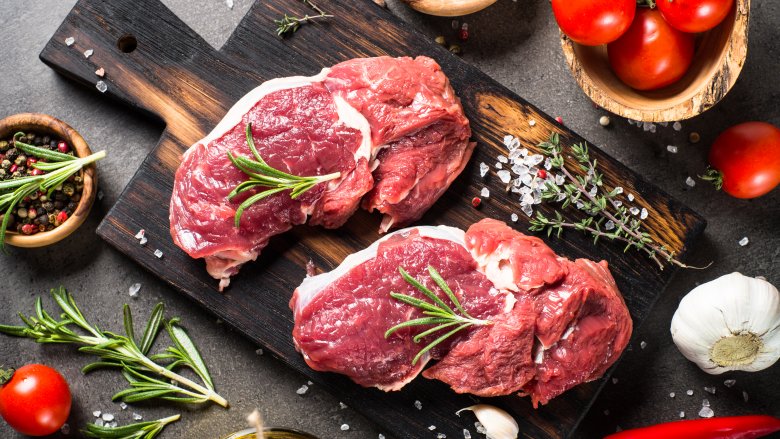
We all have those people in our families. At that place'south the ones that want their meat well-washed, and the ones that non only condemn those people, but proudly declare they want their steak still mooing. Information technology'south all down to personal gustation, sure, just there'south something else that's even more important: safety.
Co-ordinate to Healthline, food poisoning is extremely common, and it's caused by foods that contain bacteria, parasites, or viruses. Many foods take those organisms in them, just they're killed when they're cooked. When food — like meat — is eaten raw or rare, that's when some serious issues can start.
Food poisoning isn't fun, and it's characterized by things like intestinal pain, diarrhea, vomiting, headaches, fever, chills, fatigue, nausea, and an overall feeling of beingness and then sore and and then ill that y'all're debating about whether or not you always desire to swallow anything again. Anyone who has suffered through a bout of information technology can attest to just how terrible information technology is, and here'due south the thing — raw and undercooked meats are withal a popular (and sometimes pricey) dish at many restaurants. What'southward going on here? Allow's talk.
What kind of leaner are nosotros talking near?
Shutterstock
Bacteria and viruses are nonetheless one of the biggest reasons yous don't want to serve your family raw steaks or burgers, and there's a lot of them that can be present in all types of meat. Co-ordinate to the University of Nutrition and Dietetics, the Centers for Illness Control and Prevention have identified eight pathogens that are responsible for the 48 meg people who get ill (and the 128,000 people who are hospitalized) every yr with food poisoning — and many of them are constitute in meat.
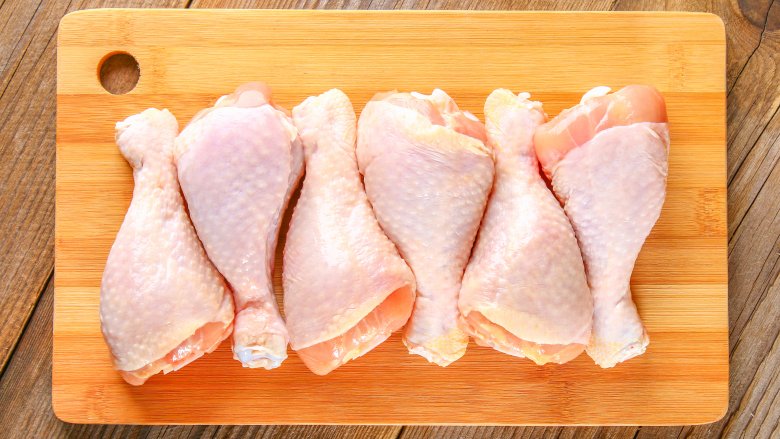
The American Meat Science Association has done a run-downwards of all the different kinds of foodborne illness and beef, they say, is a common carrier of E. coli, which can cause food poisoning — and bloody diarrhea — when it'southward ingested, usually by eating raw meat or nutrient that has come in contact with raw juices. It's as well possible for beef to comport Staphylococcus or Listeria, and the list for craven is fifty-fifty longer.
Salmonella. Staphylococcus. Listeria. East.coli. Campylobacter. They're all found in craven, and how nigh pork? They're all there, likewise, with the exception of Campylobacter. But don't worry, that'southward replaced on the listing with Yersinia, which specifically comes from the large intestine of pigs. Quite the list, isn't it?
Here's why ground meats must be completely cooked
Shutterstock
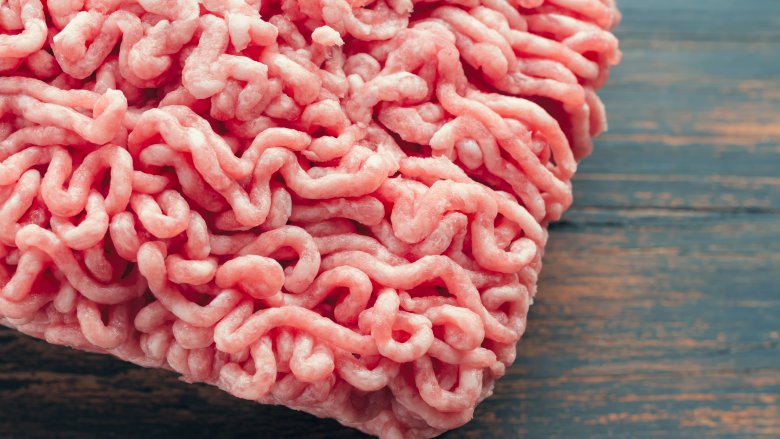
Let's wait at all ground meats, whether it's beef, chicken, turkey, pork, or lamb. The National Research Council says that absolutely all of them must be completely cooked in lodge to guarantee they're prophylactic to eat, and here's why.
When meat is first processed, almost of the bacteria lives on the surface. When it'southward basis, though, that surface surface area gets mixed all throughout the meat. That ways the entire thing could harbor bacteria that'southward going to potentially brand you — and your dinner guests — sick, but cooking it all the fashion through gets rid of the run a risk.
And the simply style to make sure you're killing all the bacteria that's potentially been mixed throughout, say, your hamburger, is to cook it to temperature.
And it'due south nearly impossible to stress merely how important that is. According to the USDA, some strains are so virulent that it just takes a couple of these microscopic organisms to cause serious disease. You might be thinking that since this bacteria is often introduced at the processing stage, it would be safer to grind your own at habitation, right? Not so, they say. In a plant overseen by the USDA, the outset cuts of meat — called primal cuts — slated for being turned into basis meat are tested for Due east.coli. Other cuts — like the ones you would use to grind your own — aren't tested. Information technology's just one more layer of protection for you lot.
No, information technology doesn't thing if information technology was frozen
Shutterstock
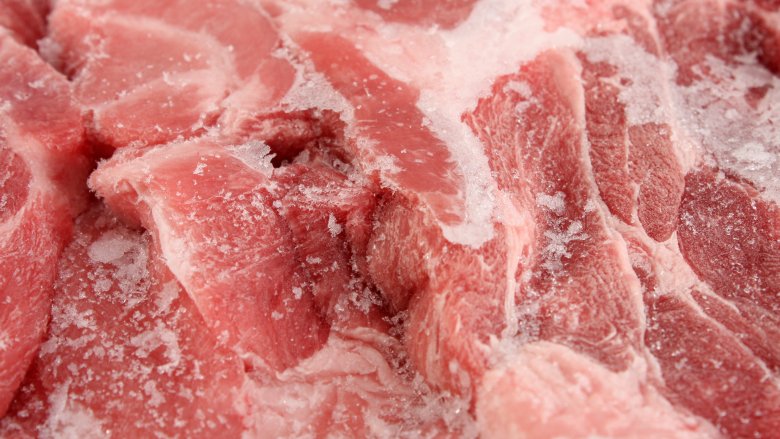
It's 1 of those bits of kitchen wisdom that seems like information technology makes sense, and information technology'south the idea that the freezing process should kill off a lot of the bacteria and germs in your nutrient. Only it'due south completely incorrect.
Co-ordinate to inquiry specialist Trevor Suslow from the University of California, Davis (via NPR), the freezing process actually helps preserve all those little microorganisms that volition make you lot sick, and the only matter information technology's actually killing are the ones responsible for making food spoil. The baddies will come correct back to life one time they're thawed.
Doesn't seem fair, does it?
And it was something that had been proven in a very real-world state of affairs. In 2013, in that location was a massive product recall of snacks, quesadillas, and cheesesteaks. All were frozen, and all were linked to a xv-land outbreak of East.coli.
Food science professor Martin Wiedmann of Cornell University said it wasn't the to the lowest degree bit surprising, and it wasn't but Due east.coli that could survive the freezing process. He added that freezing was actually the easiest way they had to store the pathogens and microbes kept in their lab for research.
Even rare steak can exist questionable
Shutterstock
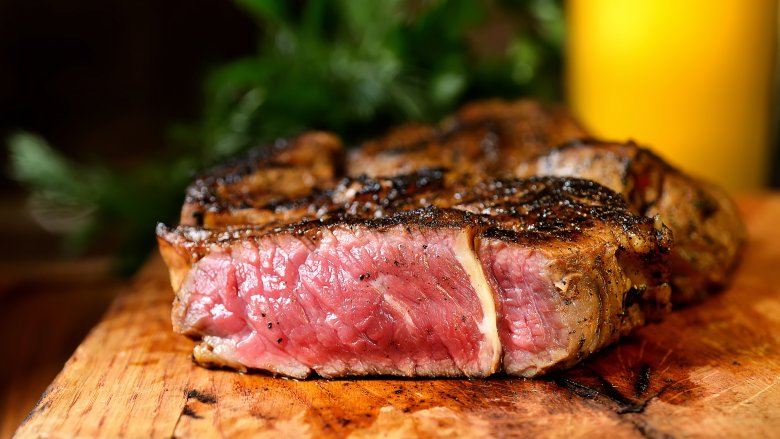
It's a widespread belief that ordering a steak that's done rare won't come with a side of food poisoning — information technology did touch on the grill, after all — only it'south not that clear-cut anymore.
In 2013, The Eye for Science in the Public Interest (via Prevention) collected and analyzed 12 years of data from the CDC. They were looking at foodborne illness outbreaks, and they found something disturbing when it comes to that steak.
The utilize of antibiotics in the livestock industry has become a huge problem for a number of reasons. 1 of the consequences of antibiotic utilise in the beef industry is that the resulting beefiness is much, much tougher, and some slaughterhouses have turned to what's called "mechanical tenderization." That's the apply of metallic blades or needles, driven into the meat to make it more tender.
But that'due south also carrying bacteria deep into the cut of meat. Where it was a previous conventionalities that bacteria just existed on the outside of a steak and it was fine if y'all just seared information technology, that's not necessarily the case anymore. You might be fine if you're sourcing antibiotic-free beef from someone you lot trust, but do you trust that eatery?
Food poisoning is a bigger bargain than it used to be
Shutterstock
Food poisoning is bad — it'southward killed people, subsequently all. But here in the 21st century, the risk is fifty-fifty greater than it used to be.
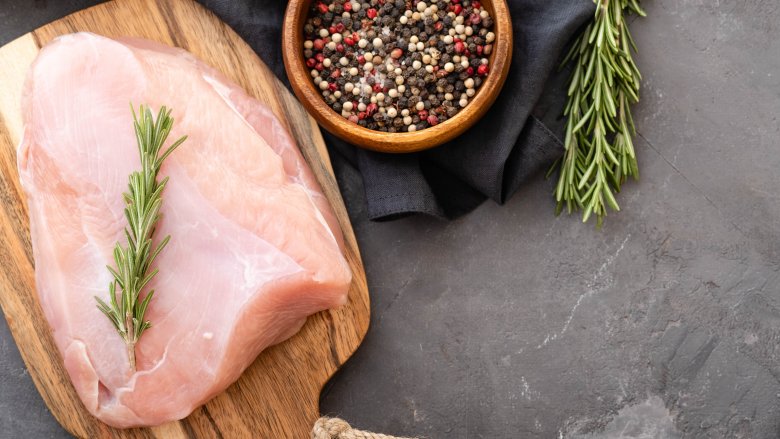
Dorsum in 2012, Consumer Reports tested 198 samples of pork. They plant Yersinia — a leaner that children are particularly vulnerable to — in a whopping 69 percent of samples, and they also found low levels of ractopamine, a drug used to promote growth in pigs. (It'south legal in the United states of america, simply illegal in the European union, China, and Taiwan.) Only the biggest problem was that many of the strains of Yersinia were resistant to the antibiotics traditionally administered to treat them, since they were routinely fed to the animals to prevent growth.
And other studies advise the problem is just getting worse. In 2018, Nutrient Safety News reported that the Nutrient Standards Agency had establish chicken and pork samples containing bacteria (including salmonella and campylobacter) that showed signs of antimicrobial resistance (AMR). The FSA added, though, that the chances of actually getting sick from eating meat contaminated with the bacteria was slim... as long equally they were handled properly and thoroughly cooked.
How does this bacteria get in our nutrient, anyway?
Shutterstock
With all the safeguards, rules, and regulations put in place effectually our food supply, all this bacteria in our meat seems like a huge oversight. So how does it all stop up in that location?
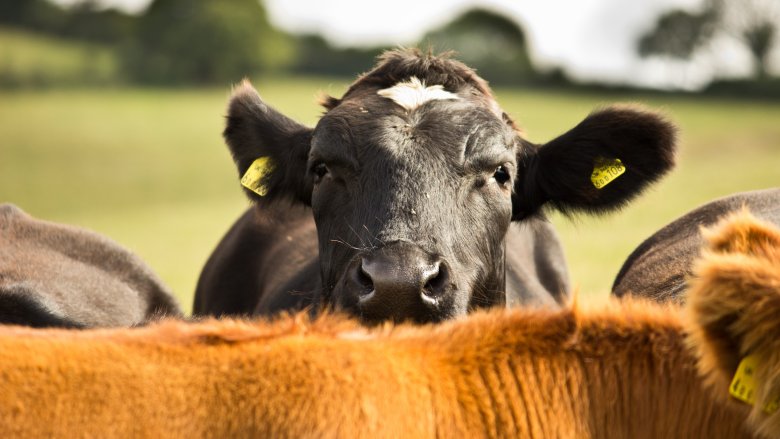
New York Times Mag writer Michael Pollan followed a cow destined to meet her maker at a slaughterhouse, and he told PBS that germs and leaner are simply a part of the manufacture.
"When the animals go far at the meatpacking constitute from their homes on the feedlot, they're carrying quite a flake of manure. ... their bodies are caked in it. ... So you need to make sure that y'all remove their hides in such a manner that y'all get all of the manure, and none of it ends up on the meat."
He adds that 99.9 per centum of the time, the methods put in identify make sure that contamination doesn't happen... but also says "... it's not a perfect organization."
And it gets weird. Eastward.coli is particularly well-suited to living in the digestive tract of an animal raised on corn — as many cattle in feedlots are. Switch corn to grass or hay, at to the lowest degree for the last few days of their lives, and the bacteria wouldn't be able to survive in their system. Researchers from Cornell University have proposed this as a style of making meat safer, merely since it'south a more expensive style to make cows that are, in the end smaller, it's unlikely to accept off on a large scale.
Tons and tons of turkey recalls
Shutterstock
So, how mutual is all this bacteria?
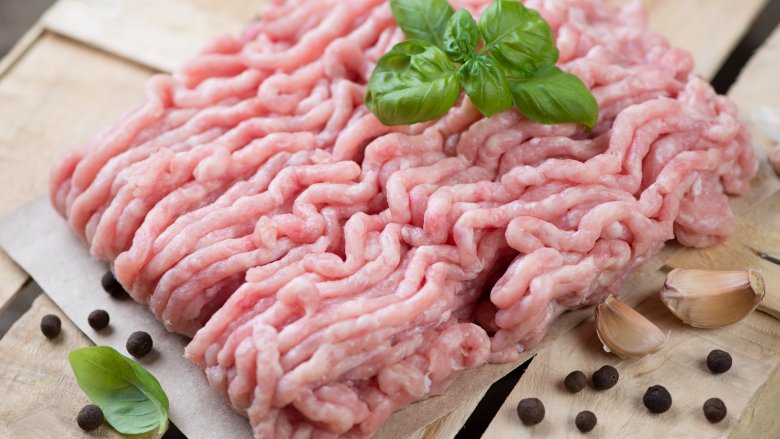
Allow's take ground turkey as an instance. Since 2011, millions and millions of pounds of footing turkey alone have been recalled due to contamination. One of the biggest recalls was issued past the Cargill Meat Solutions Corporation (via the CDC), who recalled a shocking 36 one thousand thousand pounds of ground turkey on August 3, 2011. The turkey had been establish to be contaminated with a drug-resistant strain of salmonella, and a calendar month later, they issued some other recall for some other 185,000 pounds of the same products. At least 136 people were infected, and remember — those are but reported cases.
In December 2018, Jennie-O recalled more than 300,000 pounds of ground turkey after more than 200 people reported getting sick during an outbreak that started in November of that year. It was also associated with 133 hospitalizations and one death.
Then, in March 2019, most 80,000 pounds of turkey was recalled by Butterball for — once once more — salmonella contamination (via USDA). Those are merely a few example of recalls from just one very specific type of meat — and the moral of the story is that if you retrieve it's unlikely to happen to you, you lot might want to reconsider.
The just way to get in safe
Shutterstock
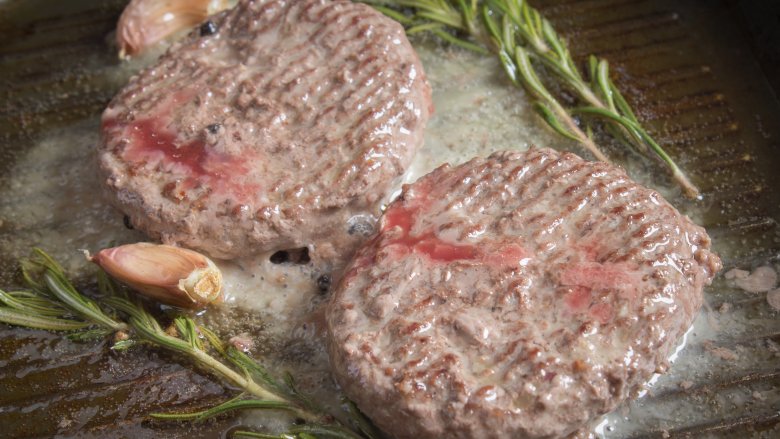
SF Gate's Healthy Eating puts it this fashion: While opting to swallow raw or rare meat isn't going to guarantee you'll go ill, information technology definitely increases the odds. The only way to exist pretty sure you're not going to get sick is to cook meat to an internal temperature that's going to kill the bacteria inside, and that varies by meat.
Food Safety has an entire nautical chart dedicated to proper temperatures, merely here's a summary: some meats — similar fresh beef, lamb, veal, pork, and ham should be cooked to 145 degrees Fahrenheit.
Ground meat and meat mixtures should be brought to 160 degrees Fahrenheit.
Poultry — including craven, turkey, duck, and goose — should be brought to 165, and here's an important footnote to that. Since these birds are oftentimes cooked with stuffing, it'due south important to make certain the temperature of the stuffing hits that mark, too.
With the processes that meat undergoes, making sure information technology's reached those temperatures in the center of the thickest part of the meat is really the only way to make certain you're not serving up a plateful of leaner along with your burgers.
Merely what almost dishes traditionally served raw?
Shutterstock
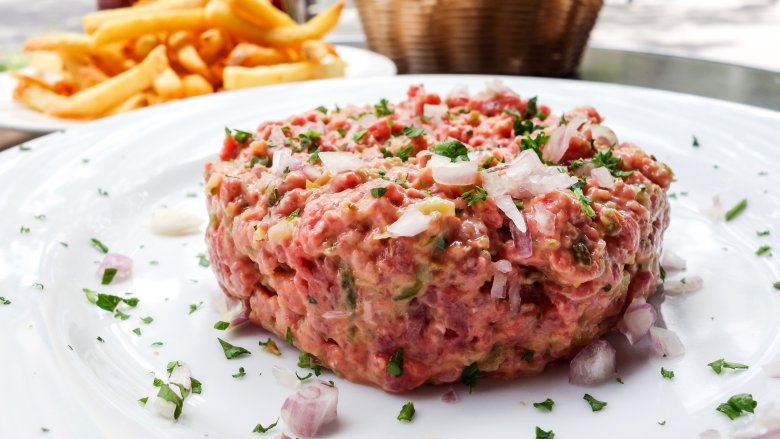
Fifty-fifty the Michelin Guide lists a whole bunch of dishes that are traditionally served raw. Take sashimi. You might recollect of fish when it comes to this one, simply it tin also be chicken, venison, or even horse. Then there's tartare (which tin also be raw beef or seafood), crudo (raw fish), carpaccio (cardboard raw beefiness), and ceviche (cured raw fish).
They're served all the time and people consume them all the time, all over the world... so what makes them safe?
Technically, they're not. According to the Academy of Diet and Dietetics, there's no way to guarantee the safe of raw meat, no thing who it'southward prepared by or where it comes from. There's e'er a adventure that it'southward going to contain some kind of bacteria that's going to make you ill, and that's why fifty-fifty these long-time raw delicacies aren't recommended for people who are particularly susceptible to food poisoning and to the effects of becoming very, very ill.
And no, you lot can't tell by looking at information technology
Shutterstock
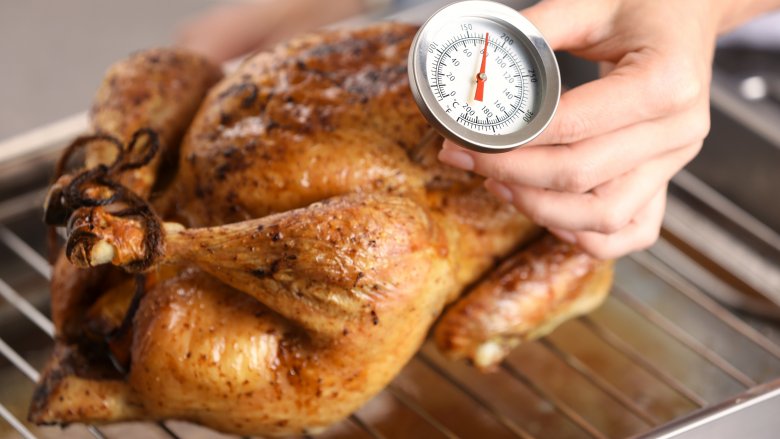
Then, you know you lot need to melt meat completely through in social club to kill any bacteria that's hanging around within it, and that'south a good thing. But in that location'due south something of a catch: according to the USDA, it doesn't matter how long you've been cooking for, you tin can't tell when meat has reached that magical, bacteria-killing temperature without using a thermometer.
Let's take hamburgers. They're done when the meat turns that succulent-looking brown color, correct? Wrong. According to their enquiry, 1 in every four hamburgers volition turn that distinctive brown colour well before the patty has reached the internal temperature you're looking for.
In that location's a ton of different options out there when it comes to food thermometers, and co-ordinate to the Academy of Diet and Dietetics, at that place'southward too a ton of different means to temp your meat — but only i is correct for the type of meat yous're cooking. For example, for roasts, burgers, chops, and steaks, insert the thermometer in the middle of the thickest part, but away from fat, bone, or gristle. The temperature of whole poultry should exist taken in the thickest part of the thigh, while for whole turkey and game birds, you're looking at the innermost part of the thigh and fly, along with the thickest area. Otherwise, you might end upwards with rare meat after all.
The meat industry is trying
Shutterstock
Is at that place skillful news on the horizon for those who like rare meats? Eh.
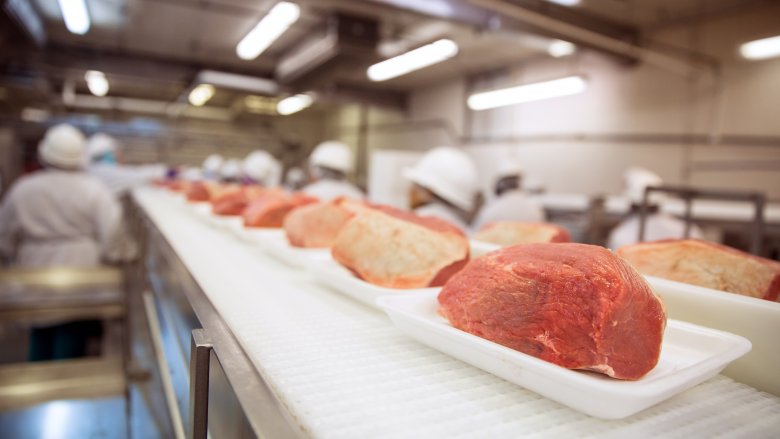
According to The New York Times, beef slaughterhouses and meat processing facilities — similar Tyson Fresh Meats — spend more than $350 million a year merely on controlling diseases and bacteria. But all the same, recalls go along happening in spite of all the precautions put in place, so whether or not nosotros're ever going to have meat we don't have to worry almost... that'south up for debate.
Michael T. Osterholm of the CDC had this to say about the problem: "If you lot gave me a million, zillion dollars and said give me a plant that doesn't have E.coli, I couldn't do it. It'southward not about the will. It'southward near the ability."
At the heart of the problem is that the meat industry — and all its rules and regulations — is dealing with a biological contaminant. And you probably wouldn't want them to fifty-fifty try all of the control methods that accept been proposed. The authorities has even suggested using radiation, proverb that's a completely safe style to impale disease-causing bacteria. Only would y'all desire them to? It's an uphill battle, and i thing experts say fourth dimension and time once again is that at that place's simply no magic bullet for getting rid of all the pathogens.
Who is at the greatest risk?

Shutterstock
So, what should you do? Simply put, cook your meat to the proper temperature — peculiarly if y'all or someone in your family falls into the high chance groups laid out by the FDA.
There's an estimated 48 million cases of nutrient poisoning each year, and they say there are some people who are more probable to suffer astringent consequences than others. Pregnant women are at the top of the list, and the FDA says information technology's non just nearly her, it'due south about an unborn babe who's also getting exposed to the bacteria. Some bacteria — particularly listeria, says Medical News Today — is linked to the threat of miscarriage and stillbirth.
Immature children are also at a high risk of serious complications from eating raw meat, because their immune systems are all the same developing. Older adults and senior citizens can be vulnerable for two master reasons: their immune systems might non be every bit quick to fight off an infection, and they may have other conditions that already weaken their systems.
And finally, those with chronically compromised immune systems are also at high chance, and those include people who have had transplants, or those diagnosed with things similar HIV/AIDS, diabetes, and cancer. They're specifically warned not to eat raw or undercooked meat of any kind, and it's improve to be safe than sorry, isn't information technology?
Source: https://www.mashed.com/151709/why-its-never-safe-to-eat-raw-meats/
0 Response to "Chances of Getting Sick From Raw Beef"
Post a Comment