Some Days I Feel Nothing Even When Surrounded by Friends and Family
This story is from The Pulse, a weekly health and scientific discipline podcast.
Subscribe on Apple Podcasts, Stitcher or wherever you get your podcasts.
A lot of messages are existence thrown at united states during this pandemic. One of them is this idea that we should all be optimizing our time in quarantine, that we should seize the opportunity to be productive.
Social media posts taunt usa: "Write that business organisation plan you've been pregnant to." "Did you lot know Shakespeare wrote Male monarch Lear during quarantine?" "If you don't come out of quarantine with a new skill, you didn't ever lack time… you lacked discipline."
— Jeremy Haynes (@TheJeremyHaynes) Apr 2, 2020If you don't come up out of this quarantine with either:
1.) a new skill
2.) starting what you've been putting off like a new business organization
3.) more cognitionYou didn't always lack the time, you lacked the discipline
If this pandemic is a golden opportunity for you to write the next Male monarch Lear, congratulations! Merely lots of us are just trying to become through the day without the added pressure of having to exist creatively productive :) https://t.co/Wny6ZOx6ZK
— Michelle Ruiz (@michelleruiz) April 9, 2020
It can experience similar a constant push-and-pull. One minute our brains tell us, "relax, it'south fine to do less." The next, it's "get off the couch and get to work."
But a growing body of research suggests that doing nothing, even letting ourselves be occasionally bored, is crucial for our cognitive health. The question is, have we forgotten how?
Pushed to the limit
Lisa Pradhan, 28, is an artist and community organizer living in Oakland, California. Being "productive" and finding meaning through piece of work have e'er been important to her.
"I really internalized at a young age that I needed to do the most," she said. "And I think I really set up a series of ways of relating to work and productivity and self-worth where I was really pushing myself to the limit."
In high school, Pradhan was one of those kids on the AP/honors track, and there was a certain culture to that.
"It'due south a career-building channel," she said. "And I retrieve by existence role of that, I really surrounded myself with kids who were pushing themselves actually, really, really, really hard."
In her junior yr, the stress caught up with her. She had to accept time off school. "Because I just started getting super sick and no one knew why. I just started having all this hurting," she said. "At the time, it felt like my trunk was falling autonomously."

But Pradhan came back, and pushed herself fifty-fifty harder in college, taking vii or eight classes a semester, while working multiple jobs and volunteering, yet "still feeling this feeling of, 'I'm not doing plenty,'" she said.
After higher, Pradhan worked a full-time job by day. By night, she worked on her ain art and joined efforts to build up arts spaces for Asian Pacific Islanders and queer folks of color in the Bay Area. She'd become to community meetings, utilise for grants, or work on a projection for a evidence until belatedly. Sometimes, she'd forget to swallow.
Not but was this "always-on" lifestyle taking a price on Pradhan'due south body, it was as well emotionally and psychologically draining. "When you lot're stressed out all the time, it'southward really hard to show upward in the earth the way you want to," she said.
Merely Pradhan didn't know how to stop, or what to change. Then, in 2017, two major incidents happened back-to-back. A stranger assaulted Pradhan and a friend while yelling slurs at them. Pradhan asked to have some fourth dimension off from piece of work, and a few days later was laid off from her job. She doesn't think her request for fourth dimension off was related to the layoff, but the timing stung. It was a breaking bespeak.
"I sorta just reached this point where I was, similar, these systems that are in identify aren't necessarily going to look out for me or my well-beingness. And and then I take to exercise that," she said. "Like, you know what? I've been doing all these different things in my life, and it hasn't brought me happiness. It hasn't brought me joy. It has only made me feel actually tired all the time."
Pradhan fabricated the determination to take the side by side year off, live off unemployment and savings, and acquire how to exist still.
"I only gave myself permission to non do anything for a while," she said. "To merely focus on having energy, and focus on mending myself."
Doing nothing deliciously
A lot of usa go, become, go, go until nosotros can't. Experts say this impulse to always exist doing something may exist specially strong for younger generations — starting with millennials, who grew up in a hypercompetitive culture of scheduled extracurriculars and college prep, not to mention lots of screen fourth dimension. Every moment of the twenty-four hours had to be filled with activity.
Now, as working adults, the effects of hustle culture are starting to catch up to many of them. Some have given these effects a name: "millennial burnout."
"This has, for years, long been a hobby equus caballus of mine," said Tim Herrera, editor of Smarter Living, a section in The New York Times that gives tips for how to live a better and more fulfilling life. Herrera is a big proponent of doing aught.
"I feel, like and so many other millennials, just kind of, information technology's been ingrained in us that we need to subscribe to hustle culture, and always need to be maximizing productivity, and always exist monetizing our hobbies, and everything should be for the purpose of career advocacy," he said.
"I think it'south poisonous and actually destructive to our own happiness and our sense of identity," he said. "And on a more practical level, it's subversive to our overall productivity."
Smarter Living has published a lot on this topic over the years. According to Herrera, there'due south always some backlash to these articles.
"Yous know, it seems like a very American idea to wait down on people who take breaks," he said. "Culturally, we are trained to see idle time as almost a grapheme flaw."
But Herrera is steadfast in his belief that we need more idle fourth dimension in our lives.
"The enquiry and scientific testify is perfectly clear, very unambiguous," he said. "Nosotros know this is how to be more productive. And you tin read whatever book on productivity, talk to any experts. Taking time for idleness and to daydream, these are tips that everybody who knows what they're talking nearly sings the praises of, because we know that they work."
One of those experts is a psychologist named Doreen Dodgen-Magee. She thinks our obsession with productivity has made us averse to colorlessness. Researchers have even found that people would rather be electrically shocked than sit alone with their thoughts.
Now, with everyone carrying mini-computers in their pockets, people take more means to fill up every moment of stillness, Dodgen-Magee said. She worries many of usa can't even wait in line a few minutes without pulling out our phones to answer to emails, or level upwardly on a game.
That's a problem, because information technology seems our brains actually need to exist bored every now and so.
"The prefrontal cortex, which is the part of the brain that is responsible for things like attuned communication and starting and stopping behaviors, self-reflection and cocky-knowing awareness, is a part of the brain that actually is stimulated to create robust wiring in the absence of other stimulation," Dodgen-Magee said.
Pregnant the brain requires some level of colorlessness for neurons in the prefrontal cortex to fire and create new connections.
The prefrontal cortex plays an important role in emotional regulation. It helps us have what Dodgen-Magee calls an internal locus of control: "the ability to soothe ourselves and come dorsum to center, rather than always needing to be stimulated or held by things exterior of united states," she said.
It makes sense: Being bored lets us larn how to be content without lark. Once y'all know what that feels like, it's easier to return to it. The calm within yourself becomes like a muscle you can use when things aren't going every bit well.
"And so it just helps u.s.a. develop these really beautifully important psychological traits of grit and resilience similar nothing else does," Dodgen-Magee said. On the flip side, when we're cognitively taxed all the time, we have trouble regulating our emotions. We're faster to acrimony, and less able to atmospheric condition frustration.

Researchers take also found that the ability to tolerate boredom is correlated with creativity.
"There is the thought that when we allow ourselves to be idle, information technology increases the likelihood that we will get uncomfortable enough that nosotros will get creative with our environs, or even just creative within ourselves, to detect means of having meaningful experiences," Dodgen-Magee said.
When she talks well-nigh idleness, she doesn't hateful taking a break from work to scroll Instagram, she said. She means resist filling the moment. Allow your listen migrate aimlessly.
"Simply sitting and looking out of a window, or sitting on 1's porch and watching equally the day goes past," she said. "The Dutch call this niksen, which means 'doing nothing deliciously.'"
The myth of productivity?
Just niksen feels unproductive, correct? It might even brand y'all feel anxious, or guilty. Why is that? Or, conversely, why do we care so deeply about being busy and productive — all the time?
Silvia Bellezza has a hypothesis. She's a professor of marketing at Columbia Academy's business school, and she studies status symbols. She became interested in our obsession with being busy because of a contradiction she noticed.
In her field, the classic thought is that leisure time is a status symbol. An American economist named Thorstein Veblen wrote nearly that in the late 1800s.
"He talks most the thought that the extremely wealthy people are the ones who tin beget not to work," Bellezza said. "And so he specifically says that 'conspicuous abstention from labor' becomes a manifestation of the fact that y'all're particularly wealthy."
Only all effectually her, Bellezza saw pretty much the opposite.
"People are bragging all the time about working nonstop, not going on leisure, even when you're supposed to be on holiday, bragging about the fact that you're working," she said.
Bellezza idea: Today, being busy is the condition symbol. She tested this out, a bunch of dissimilar means, to come across if it was actually true.
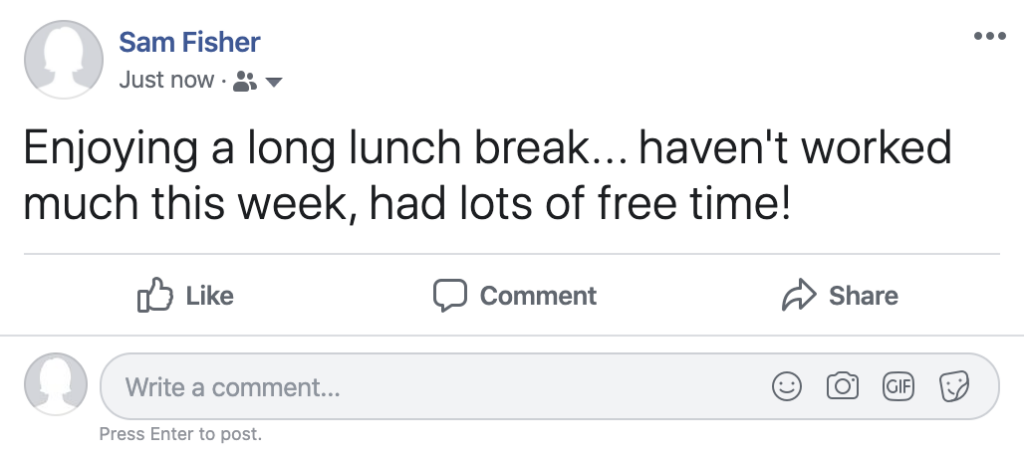
For example, she created fake Facebook profiles. One profile would be filled with posts about working nonstop, being super busy. The other would have posts about having tons of free fourth dimension. Then she asked written report participants to rate the profiles: Do you think this person is wealthy? How would you rank their social status?

"What we find recurrently is that there is this significant divergence," Bellezza said, "such that the person who's working all the time is seen as higher condition than the person who's engaging in leisure."
Merely that was only true for participants in the The states. When Bellezza did a similar experiment with Italians, she plant the opposite.
"For the Italians, as presently every bit they see the person who'due south not working, they immediately recall the person is well-off. That's why they're non working," she said.
Bellezza then looked into why participants in unlike countries felt the way they did. And it came down to perceived social mobility — aka the American Dream.
"In countries like the U.S., in which people really think that through hard work, yous tin can make it to the top of order, nosotros discover that in those countries being busy at work and being a workaholic is typically seen very positively," she said.
Then what has changed in the The states since when leisure was seen equally the marking of wealth? According to Bellezza, it's the shift toward a knowledge-intensive economic system, one in which workers are encouraged to constantly build and invest in their ain capital, by going to the all-time schools, paying for specialized degrees, and overworking.
"The idea is that in that location is a market for human capital letter," she said. "The extent to which we are busy at work, this implies that we're very in demand. And scarce. If you meet a person that's driving an expensive auto, you may recall of them equally specially wealthy considering what they own is scarce. When y'all're bragging near being decorated and overworked, the scarce resources is really your brain."
Malcolm Harris is a Philadelphia-based journalist and writer of a book called "Kids These Days: Human Uppercase and the Making of Millennials." In the book, he argues that this restructuring of labor is precisely what constitutes the millennial feel.
"Millennials know that we need to make ourselves useful for employers. It's not a question of just going and picking up a job. Information technology's 'how do you lot become career set?' And we internalize these injunctions," he said.
For instance, Harris said, instead of paying to railroad train y'all, companies today expect employees to train themselves.
"The outcome has been nosotros have the most educated cohort in American history, right? However, that hasn't led to the skillful jobs that were promised," he said.
To explicate why, Harris pointed to something called the productivity-pay gap. Around the 1980s, when millennials showtime being born, you begin to see a widening gulf betwixt labor and compensation.
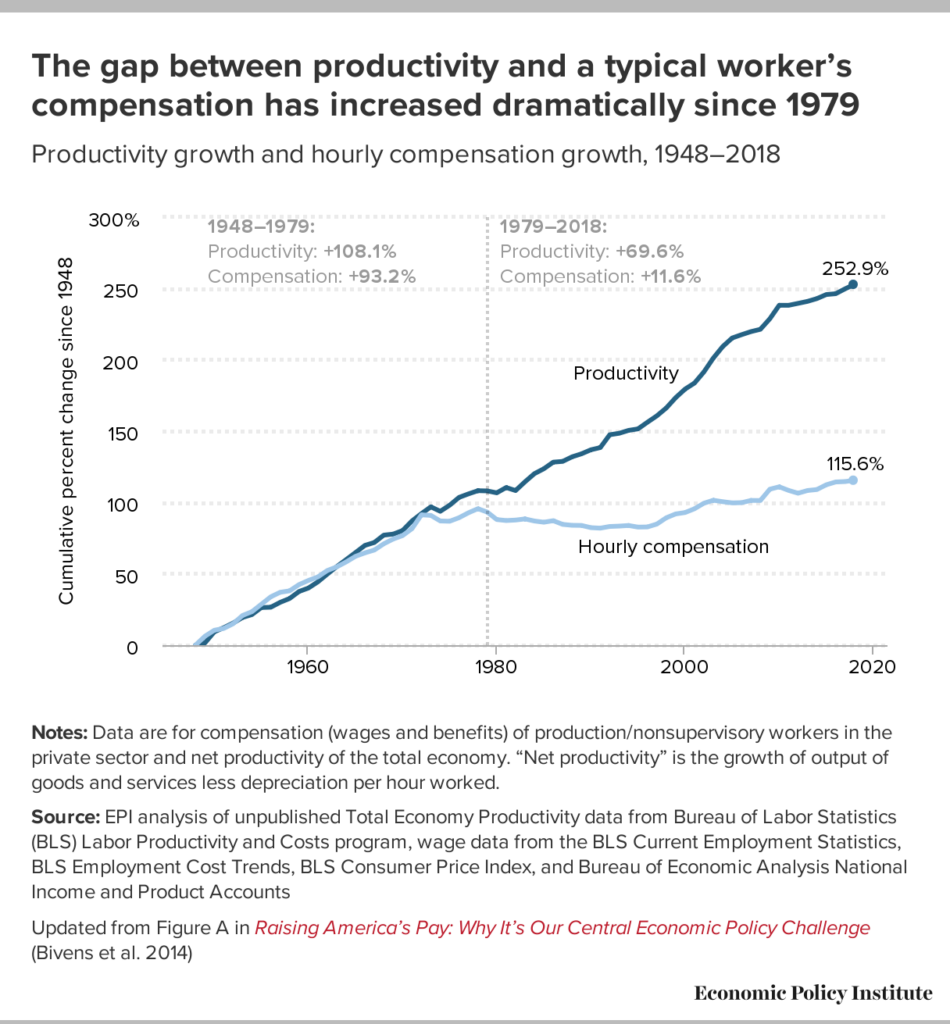
"People stopped getting paid more for their work," Harris said, "and at the same time they continue to become more than productive. And this divergence grows and grows and grows and grows. And it's kept growing over the past few decades."
All this feeds into hustle culture, according to Harris. Workers take to compete more than for wages, so they push themselves harder. They take on more educational debt, which requires them to work more than.
"It builds on itself. And it keeps building," he said.
All the while, the American Dream, the affair that causes us to contemptuousness laziness and prize industriousness — "sometimes that'southward true, and by and large we know information technology's non very truthful," Harris said.
Today, many economists and sociologists say, the circumstances into which you lot are born are more decisive of life outcomes than how difficult you piece of work. That's why Harris thinks, ultimately, the solution to productivity culture is not an private one.
"It's just past thinking about these questions collectively that we tin can start to come upwardly with answers that might exist appropriate to the question itself. Which is, how practise we solve this every bit a social question, not how practice I solve this as a person?" he said.
Doreen Dodgen-Magee, the psychologist, agreed with Harris.
"The grind-and-hustle mindset is actually fed by a capitalistic culture that is based on the thriving of sure parts of our populace and the oppression of others," she said. "And the folks who are doing the majority of the grinding and hustling are given less and less opportunities for things like balance, for things like prioritizing self-intendance."
But Dodgen-Magee also thinks it's worth it for people to work in piffling moments of mental balance whenever they can. She believes information technology all helps.
"Nosotros tend to think about things in a very strong all-or-nothing style," she said. "And that'due south where I'yard trying to break in to say it can be a little more gray. If we take very, very stressful piece of work environments, then learning the practice of taking even three minutes to do some things like breathing and to let my mind kind of wander, fifty-fifty those tiny moments can go a long way toward soothing the self."
Dodgen-Magee recognizes there's an irony to the "work less, you'll become more done" statement. She worries it reinforces the very productivity mindset she's trying to fight. For instance, she said, remember of the trends toward quantifying leisure: Now, the uncomplicated act of going on a walk tin can become all almost tracking your step count.
Jordan Etkin, a professor of marketing at Duke Academy's Fuqua Schoolhouse of Business, calls this "productive leisure." And in that location are consequences to leisure getting hijacked by productivity, she said.
In her research, she's establish that even simple acts of monitoring — similar, request people to bank check off shapes that they've filled in in a coloring book — tin can counteract the replenishing effects they would have gotten from coloring aimlessly.
If we're coloring with no other job at hand, we free our minds from having to focus, according to Etkin.
"Maybe nosotros're thinking well-nigh what color to use. Maybe nosotros're thinking about the shapes. Maybe we're just sort of thinking most our twenty-four hour period and ruminating on some upcoming plans," she said. The point is, "that's very restorative for our brains."
That'southward why Dodgen-Magee said unwinding has to be its own reward. Do nothing for the sake of doing nothing.
'Yous're doing enough'
As Lisa Pradhan in Oakland forced herself to take a intermission, after having been laid off, she felt herself slowly adjusting.
"I did feel a deep sense of clarity in my life," she said. "I retrieve there'southward a lot of things that nosotros can fixate on in this world. When I really sabbatum with it — and had time to think through, 'Why am I choosing to do X matter?' — and to actually have the space to hold that, and to non feel too overwhelmed to have on those questions, I found that I did make different choices almost what matters and what doesn't matter."
Some days, what mattered was honoring her need to unplug or be lazy. "OK, I'chiliad not gonna have my phone on for today," she said. "And I'm just going to do whatever I feel like doing, and if what I feel similar doing is just hanging out in my bed all twenty-four hour period, then that's what I need correct now."
Other days, it was creating art, without needing the terminate result to be perfect. "And I ended up being incredibly productive when that wasn't my goal per se," she said.
Eventually, Pradhan got a new full-time job, working for an environmental justice nonprofit. She's gotten ameliorate at noticing when she's overextended — like when she has back or stomach pain, or if she tin can't fathom reading a book at dark — and she's careful not to take on too much, at work and in the residuum of life.
"I kind of suspension every now so, and I'g just similar, 'You're doing enough, Lisa. You're doing more than enough. Yous're doing great,'" Pradhan said. "I really remind myself that I am enough. Every bit I am in this earth, that is plenty."

Source: https://whyy.org/segments/why-stillness-is-crucial-for-your-brain-during-this-pandemic/
0 Response to "Some Days I Feel Nothing Even When Surrounded by Friends and Family"
Post a Comment